

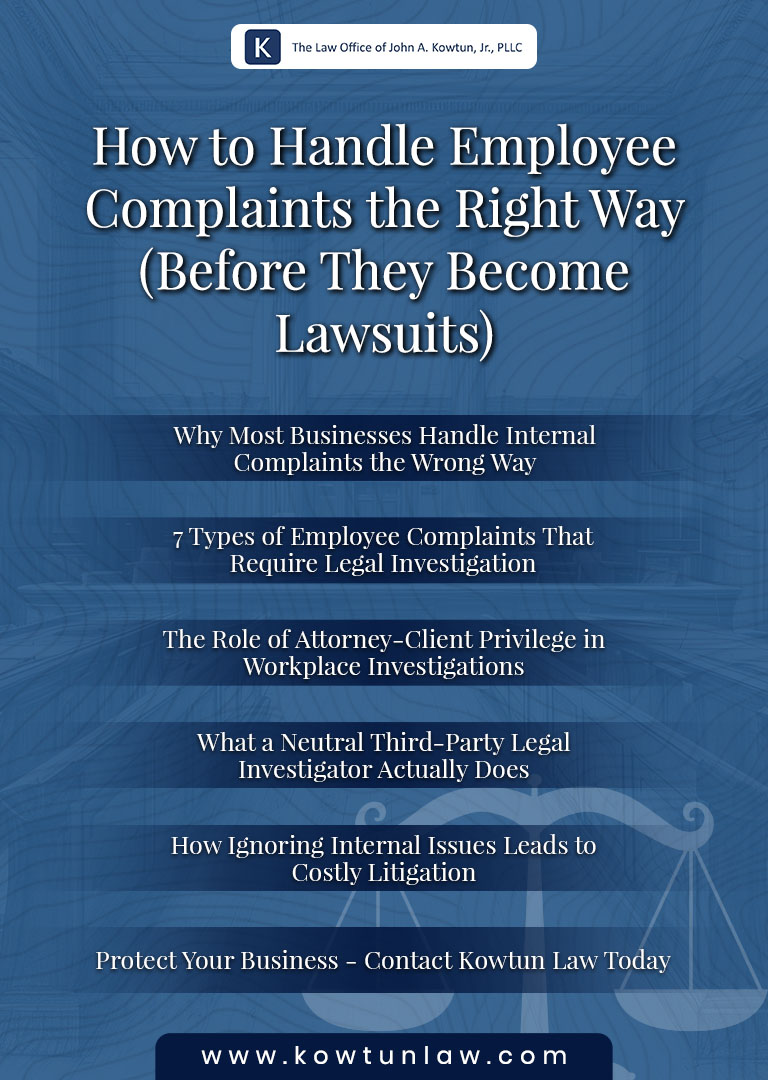
How to Handle Employee Complaints the Right Way (Before They Become Lawsuits)
A supervisor forwards an email late in the day after an employee reports repeated comments, uneven treatment, and a meeting that ended with tears. The owner wants the issue handled quietly, asks one manager to talk to both sides, and expects the problem to cool off by Monday. Instead, more employees hear about it, text messages start disappearing, and the business is left deciding what to document, who to interview, and how serious the complaint may really be.
Employee complaints become legal problems when a business responds informally, documents too little, or appears to protect the wrong people. Once that happens, the issue can affect morale, turnover, productivity, and the company’s position if a later claim involves harassment, retaliation, discrimination, or wage violations. A workplace investigation attorney Texas employers trust can help sort facts from assumptions, establish a fair process, and preserve options to help reduce business risk.
Why Most Businesses Handle Internal Complaints the Wrong Way
An employee raises a concern with a manager. The issue sounds personal at first. The manager wants to calm things down quickly. So the complaint is handled informally, a few conversations happen, and everyone is told to move on. That approach feels sufficient in the moment. In reality, it can create more risk because the business acts before it fully understands what happened, who was involved, and what legal duties may already be in play.
The answer is not to treat every complaint like a crisis, but to treat every complaint seriously and to assess it the right way. Some issues can be resolved through normal management, while others call for a more formal employee complaint investigation because they involve discrimination, harassment, retaliation, safety, fraud, or other conduct that can expose the business to real liability. Once that line is crossed, the instinct to “keep things moving” is no longer enough. A careful response at the start protects facts, protects people, and gives the business a better chance to respond before the issue becomes a claim.
7 Types of Employee Complaints That Require Legal Investigation
Not every workplace concern needs the same response. Some complaints involve performance, personality, or routine supervision. Others raise legal exposure from the moment they are reported. That is where businesses often make the wrong call. They assume a quick internal chat is enough because they want to avoid disruption. The problem is that the risk does not disappear just because the process stays informal. When a complaint touches protected conduct, abuse of authority, or serious misconduct, the business needs a process that is more disciplined, more neutral, and better documented from the start.
- Harassment Complaint: Allegations of sexual harassment or other unlawful harassment require prompt fact-gathering — if the business minimizes the report, the delay itself may later be used as evidence of an inadequate response.
- Discrimination Complaint: Claims tied to race, sex, age, disability, religion, or other protected categories require careful review — a weak response can turn one employee complaint into a broader pattern claim against the company.
- Retaliation Complaint: Reports that an employee was punished for speaking up need close legal attention — retaliation claims often become more dangerous than the original complaint because they suggest the business knew and reacted badly.
- Wage and Hour Complaint: Concerns about unpaid overtime, off-the-clock work, or improper classification can affect more than one employee — if ignored, the business may face back-pay demands, penalties, and group claims.
- Safety or Compliance Complaint: Reports involving workplace safety, regulatory issues, or internal misconduct should not be brushed aside — once documentation shows the company knew of the issue, failing to act can carry heavy legal and reputational costs.
- Fraud or Financial Misconduct Complaint: Allegations involving theft, falsified records, expense abuse, or misuse of company funds demand a structured review — poor handling can lead to lost evidence, deeper financial loss, and credibility problems later.
- Threats or Serious Misconduct Complaint: Complaints about violence, intimidation, or coercive conduct require urgent and neutral attention — if the business underreacts, the fallout may include injury, turnover, and claims that the workplace was left unsafe.
The key question is not whether the complainant feels uncomfortable. The key question is whether the issue creates enough legal or business risk that a more formal process is needed.
The Role of Attorney-Client Privilege in Workplace Investigations
Attorney-client privilege matters because it can help protect certain legal communications made for the purpose of getting or giving legal advice. In a workplace investigation, that protection can be useful, but it is often misunderstood. Some businesses assume that copying a lawyer on an email makes everything privileged. Others assume any investigation tied to counsel is automatically protected. Neither assumption is safe. Privilege depends on purpose, structure, and how the communication is handled. If the business treats it loosely, the protection may be weaker than expected.
This matters most when the complaint is serious and the company is already thinking about legal exposure. In those cases, the investigation should be designed carefully. A workplace investigation attorney is often helping the business do more than collect facts. The attorney may also help frame the legal purpose of the review, identify what should be documented, decide who needs access, and reduce the risk of creating records that later hurt the company more than they help. Privilege is not a magic shield. It is a legal protection that works only when the process is built with discipline.
- Legal Purpose: Privilege is strongest when the communication is for legal advice, not general business discussion — if the real purpose is unclear, a later dispute may expose internal communications the business expected to stay private.
- Attorney Direction: Investigations led or directed by counsel are usually more defensible on privilege questions — without that structure, sensitive findings may be treated as ordinary business records.
- Need-to-Know Sharing: Privileged material should stay limited to people who truly need it — broad internal circulation can weaken the claim that the communication was meant to stay protected.
- Interview Notes and Summaries: Notes taken for legal advice should be handled with care and consistency — careless wording or wide distribution can create discoverable material that shapes the case against the business.
- Mixed Legal and HR Purposes: When legal advice and routine HR management get blended together, protection becomes less certain — that confusion can lead to disputes over what the other side gets to see.
- Outside Communication: Sharing legal findings with outsiders can affect privilege analysis — once sensitive information leaves the protected circle, the business may not be able to pull it back.
- Final Reporting Decisions: The form of any report should be considered before it is written — a poorly planned written conclusion can become the document everyone focuses on in later litigation.
Privilege is useful, but it is not the primary goal. The bigger goal is a sound investigation process that protects the business while still allowing it to reach fair and informed decisions.
What a Neutral Third-Party Legal Investigator Actually Does
A neutral third-party legal investigator does not step in simply to validate what management already believes. The role gathers facts, tests competing accounts, preserves process integrity, and helps the business respond from a more defensible position. That neutrality matters when the complaint involves a manager, a senior employee, multiple witnesses, or facts that internal staff may not be well placed to assess on their own. A structured outside review also helps when employees no longer trust the company to investigate itself. In this situation, a third-party investigation is less about optics and more about credibility.
- Defines the Scope: The investigator identifies what issues need to be examined and what does not — without a clear scope, the process can drift and miss the facts that matter most.
- Preserves Evidence: Relevant emails, messages, policies, and records are identified early — if that step is delayed, key evidence may disappear or become harder to trust.
- Interviews Witnesses: The investigator speaks with the complainant, the accused, and other relevant witnesses in a structured way — poor interviews often create confusion, inconsistency, and later challenges to the process.
- Assesses Credibility: Conflicting accounts are tested against documents, timing, and detail — if no one evaluates credibility carefully, the business may act on the wrong version of events.
- Maintains Neutrality: The process is kept independent from internal politics and personal loyalties — when neutrality is missing, even a correct outcome may still look unfair.
- Reports Findings: The investigator organizes the facts and identifies supported conclusions — if findings are vague, the business may struggle to make decisions that are defensible later.
- Supports Next Steps: The business can then consider discipline, policy changes, training, or other action on a stronger factual record — without that foundation, the response may create more risk than the original complaint.
A neutral process does not guarantee that everyone will like the outcome. It does make the outcome easier to defend if it is later challenged.
How Ignoring Internal Issues Leads to Costly Litigation
Businesses usually do not get sued because a single complaint was made. They get sued because the complaint was mishandled, delayed, ignored, or answered in a way that made the problem worse. When an employee reports harassment, retaliation, discrimination, or serious misconduct, the business is being given a chance to respond before outside agencies or courts step in.
If that chance is missed, the complaint can grow into a record of inaction. At that point, the issue is no longer just what happened between employees. It becomes a question of what the company knew and how it responded.
That is why internal complaints should never be treated as noise to manage away. A poor response can lead to turnover, broken morale, lost documents, inconsistent witness stories, and a much harder defense later. It can also negatively impact other employees who were watching quietly to see whether the company takes its own rules seriously.
In many cases, the legal claim that finally gets filed is shaped as much by the employer’s response as by the original conduct itself. A careful process does not eliminate every future dispute, but it can reduce exposure and give the business a stronger footing if the issue gets escalated outside the company.

Protect Your Business — Contact Kowtun Law Today
A workplace complaint does not become less serious because it is handled quietly. In many cases, the real risk comes from an inadequate or incomplete response, not from the first report itself. A careful investigation helps the business understand the facts, respond fairly, and reduce the chance that an internal issue grows into a larger legal problem.
When a complaint raises questions about harassment, retaliation, discrimination, or other serious workplace conduct, it often makes sense to slow down and assess the issue with care. Kowtun Law’s Investigative Legal Services are built around neutral third-party legal investigations that bring clarity to sensitive internal matters, and its blog posts also address related workplace risk issues for business owners who want to respond thoughtfully before problems escalate.
If a complaint has been raised and the right response is unclear, a confidential consultation with Kowtun Law can help assess the situation before it becomes harder to manage.
FAQs
Should Every Employee Complaint Trigger a Formal Investigation?
No. Some employee complaints can be handled through normal supervision, coaching, or routine HR follow-up. The key is early assessment. If the issue involves harassment, discrimination, retaliation, safety, fraud, or serious misconduct, a more formal investigation may be appropriate. A business should decide based on risk, facts, and legal exposure, not just on how easy the complaint seems to resolve.
How Quickly Should a Business Respond to an Internal Complaint?
A business should respond promptly, even if the full investigation cannot start the same day. Early action helps preserve evidence, calm uncertainty, and show the complaint was taken seriously. Delay creates its own problem because witnesses talk, documents get lost, and the business may later have trouble explaining why it waited once it knew a serious issue had been raised.
Can a Manager Investigate a Complaint About Someone in Their Own Team?
Sometimes, but often that is not the best approach. If the complaint involves favoritism, bias, retaliation, or a supervisor who has influence over the process, the internal review may not appear neutral. That does not always mean outside counsel is required, but it does mean the business should pause and ask whether the investigator will be viewed as truly independent.
Should Anonymous Complaints Be Taken Seriously?
Yes. Anonymous complaints still deserve evaluation based on the facts available. The lack of a named source may make the process harder, but it does not make the report meaningless. If the complaint describes conduct that would create legal or safety risk, the business should assess it carefully and document what steps were taken in response.
Can a Workplace Investigation Stay Fully Confidential?
Not completely. Businesses can and should limit discussion to those who need to know, but most investigations require speaking with witnesses and gathering facts from multiple sources. Promising total confidentiality is usually a mistake. A better approach is to explain that the business will handle the matter as discreetly as reasonably possible while still conducting a fair review.
What Records Should Be Preserved After a Complaint Is Made?
The business should preserve relevant emails, messages, personnel records, policies, schedules, time records, complaints, and any notes tied to the issue. The exact list depends on the allegation. Early preservation matters because later gaps in documents can hurt the business even if nothing improper happened. Missing records often create suspicion where a prompt record hold could have prevented it.
What If the Complaint Turns Out to Be Unfounded?
A complaint that is not substantiated should still be documented carefully. The business should record what was reviewed, who was interviewed, what conclusions were reached, and what follow-up steps are needed. An unfounded complaint does not mean the process was unnecessary. It often means the process worked as it should and gave the business a reliable basis for decision-making.
When Should a Business Bring in Outside Counsel or a Neutral Investigator?
Outside help is often worth considering when the complaint involves senior leadership, legal exposure, credibility concerns, repeated internal issues, or facts that internal staff are not well equipped to investigate neutrally. It can also help when the business wants a more defensible process from the start. The cost of early guidance is often smaller than the cost of repairing a weak investigation later.
Recent Blogs
-

What Are the Benefits of Having a Detailed Operating Agreement for a New Business?
-
What Business Owners Must Know Before Signing Contracts
-
LLC vs Corporation vs Partnership: How to Choose the Right Business Structure in Texas
-
Independent Contractor vs Employee: What Your Business Contract Must Clearly State
-
Corporate Fraud and Embezzlement: How Businesses Should Respond When the Numbers Don’t Add Up




Peace of Mind for Your Business Decisions
Schedule your confidential consultation today!
© Copyright 2025-26 All Rights Reserved.