

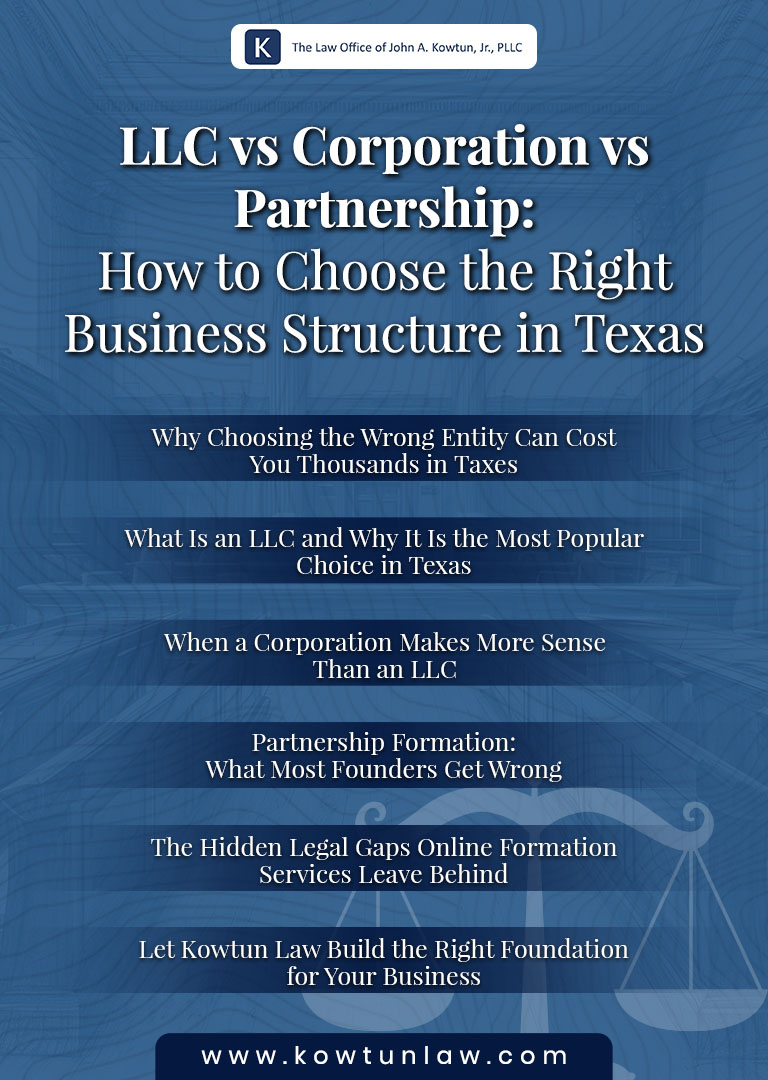
LLC vs Corporation vs Partnership: How to Choose the Right Business Structure in Texas
You are ready to start the business. The name is set. The first contract may be closed. Then one question stops the process: should you form an LLC, a corporation, or a partnership?
For most owner-managed businesses, an LLC is often the best starting point because it gives liability protection with more flexibility than a corporation. Still, that is not always the right answer. Some businesses are better served by a corporation, and some founders move into a partnership without fully seeing the legal and tax risks they are taking on.
That is why this choice deserves more consideration than just a quick online filing. Your business structure affects how profits are taxed, how decisions are made, how new owners come in, and how much distance exists between your business liabilities and your personal assets.
If you want to avoid costly clean-up work later, it helps to get clear on the structure before the business starts taking on real money, real contracts, and real exposure.

Why Choosing the Wrong Entity Can Cost You Thousands in Taxes
Many founders think entity choice is only about liability. It is not. The structure you choose also affects how income is reported, how owners are paid, what filings are due each year, and what tax issues may follow once the business starts making real profits. A formation choice that feels simple at the start can become expensive once revenue grows or ownership changes.
That is where many business owners get caught off guard. A single-member LLC may be easy to start, but its default tax treatment may become costly once profits climb. A corporation may offer advantages in the right situation, but it can also create added payroll duties and different tax results if it is chosen too early or for the wrong reasons.
A general partnership may seem easy because two people trust each other, yet that ease can hide serious exposure. In short, the wrong entity does not always create trouble on day one. More often, it shows up later in the form of tax waste, filing mistakes, and expensive legal cleanup work.
What Is an LLC and Why It Is the Most Popular Choice in Texas
An LLC is popular because it gives many business owners a practical middle ground. It can separate personal assets from business risk, it usually offers pass-through taxation by default, and it often comes with fewer internal formalities. That combination makes it a strong fit for many closely held businesses, service firms, family companies, and owner-managed ventures.
Kowtun Law’s entity formation services describe this work as helping clients choose a structure that limits personal liability and supports the best-fit tax setup for the business.
- Limited Liability: This can help separate your personal assets from many business debts and claims — without that separation, one lawsuit or unpaid obligation may reach assets you never planned to put at risk.
- Pass-Through Tax Treatment: Business income often passes through to the owners’ personal returns by default — that may keep early-stage tax reporting simpler, but the wrong tax election later can cost the business more than expected.
- Flexible Management: An LLC can often be run by its owners or by managers — if those roles are not defined clearly, day-to-day authority can become a source of conflict.
- Operating Agreement Control: The owners can usually set internal rules in an operating agreement — if that document is weak or missing, disputes over voting, profit splits, and exits become far harder to resolve.
- Fewer Formalities: Many LLCs have fewer recordkeeping demands than corporations — that convenience helps only if the owners still treat the company as a real separate business.
- Good Fit for Small and Mid-Size Businesses: Many founders choose an LLC because it is practical and adaptable, but choosing it incorrectly can still leave tax and ownership issues unresolved.
That is why the LLC is popular, but popularity alone should not decide the issue. The better question is not what most founders choose. The better question is what fits your ownership plan, revenue model, risk exposure, and growth strategy.
Why Many Founders Start With an LLC
An LLC often works well when you want legal protection without building a heavier internal structure than the business needs. That matters for companies where the owners are active in daily operations and want flexibility around management and distributions.
It also works well when the business is still shaping its long-term path. You may start with one owner and later add another. You may want pass-through taxation now and then revisit the tax side once the numbers justify it. That kind of flexibility is one reason LLCs remain the most common first choice for many Texas businesses.
When a Corporation Makes More Sense Than an LLC
A corporation can be the better choice when the business needs a more formal ownership structure, plans to raise outside capital, expects to issue stock, or wants a governance model with clearer separation between owners, directors, and officers.
It may also make sense when a founder’s compensation plan and projected income point toward a different tax setup than a default LLC offers. For a closer look at how these structures compare on paper, see Differences Between LLC, Corporation, and Partnership.
- Investor Readiness: Corporations often fit better when outside investors expect stock ownership and formal governance — trying to force those expectations into the wrong structure can slow deals and create avoidable friction.
- Clear Corporate Roles: Directors, officers, and shareholders usually have more defined legal roles under the Texas Business Organizations Code — without that clarity, control issues can grow as the company expands.
- Stock Ownership Planning: Corporations are often better suited for issuing and transferring shares — if equity planning is handled loosely, future ownership disputes can become expensive fast.
- Payroll-Based Tax Planning: Some businesses consider corporate tax treatment for compensation reasons — if payroll rules are ignored or handled poorly, the tax savings can disappear under penalties and back taxes.
- Formal Decision-Making: Corporate formalities create a record of major approvals and actions — when those records do not exist, disputes over authority become harder to untangle.
- Long-Term Growth Structure: A corporation can suit businesses planning for faster expansion such as through raising significant outside investment.
A corporation is not a better choice because it sounds more established. It is a better choice only when the legal and financial realities of the business call for that structure.
Where the Corporate Option Often Fits Best
Some businesses are built from the start with investors, officers, equity plans, or sharper lines of control in mind. In those cases, the extra formality may not feel like a burden. It may feel like the right level of structure for the business model.
Still, many smaller companies choose a corporation for image rather than function. That is usually the wrong reason. Structure should follow the business plan, not the other way around.

Partnership Formation: What Most Founders Get Wrong
Partnerships often begin with speed and trust. Two people agree on the idea, split the work, and move forward. The problem is that trust does not answer legal questions. It does not explain who can bind the business, how profits will be divided, what happens if one person wants out, or who carries the risk if something goes wrong. That is where many founders make a big mistake: they treat partnership formation like a personal understanding when it needs to be treated like a legal and business decision.
This is also where the real exposure lands. In a general partnership, one partner’s actions can create liability for the other. If the terms are vague, the business may run smoothly until money, workload, or authority becomes uneven. By then, the cost of fixing the structure is much higher than the cost of setting it up properly at the start.
- No Written Partnership Terms: A verbal understanding leaves core rights and duties unclear — once profit, debt, or workload changes, that gap often turns into conflict.
- No Authority Limits: Each partner may think the other knows the limits — one bad contract or financial commitment can bind the whole business.
- No Clear Profit Split: Founders often assume fairness will sort itself out — unclear distribution terms can create resentment once revenue starts coming in.
- No Exit Plan: Many partnerships skip buyout rules and withdrawal terms — when one partner wants out, the business may face chaos at the worst time.
- No Liability Shield: A general partnership does not separate the owners from the business in the same way an LLC can — one partner’s mistake may become the other partner’s personal problem.
- No Dispute Process: Founders often avoid planning for disagreement — without a process, even a manageable dispute can stall operations and drain cash.
For many founders, the better route is not avoiding shared ownership. The better route is putting that ownership inside the right structure and documenting the terms before pressure hits the business.

The Hidden Legal Gaps Online Formation Services Leave Behind
Online formation services are built to file documents quickly. That can be useful for basic paperwork, but paperwork is not the same thing as legal planning. A filing service usually does not sit down with you to review management authority, ownership rights, exit terms, tax elections, or the risk that one founder may be taking on more exposure than expected. Online filing services give you a formed entity. It does not always give you a well-planned one.
That gap matters more than most founders realize. The biggest problems usually do not start with the certificate of formation. They start later, when the business needs a solid operating agreement, a clean ownership structure, clear signing authority, or a more thoughtful tax posture.
Kowtun Law handles matters personally and focuses on clear, actionable guidance for business owners.
If you are only deciding when to form a business entity, it helps to remember that filing is only the first step; the legal setup behind that filing is what often protects the business later.
Let Kowtun Law Build the Right Foundation for Your Business
Choosing between an LLC, a corporation, and a partnership is not only a filing decision. It affects taxes, liability, ownership rights, and the business’s ability to handle growth or conflict later. Getting the structure right early usually costs less than repairing the damage after the business is already moving.
Kowtun Law focuses on entity formation and related business legal issues for entrepreneurs, investors, and business owners who want clear guidance and personal attention. The firm aims to give clients practical recommendations that helps guide informed decision-making.
If you are unsure which structure fits your business, a confidential consultation can help you make that decision with clarity.
FAQs
How Does a Single-Member LLC Pay Taxes by Default?
By default, a single-member LLC is generally treated as a disregarded entity for federal tax purposes. That means the business income usually flows through to your personal tax return. It is simple, but once profits grow, that default setup may create a heavier self-employment tax burden than the owner expected.
Can an LLC Switch to S-Corp Taxation to Save Money?
Yes, an LLC can often elect S-corp tax treatment if it meets the rules and files on time. That can reduce self-employment tax on part of the business income. Still, it does not remove tax from the owner’s salary, and it adds payroll duties that should be weighed carefully.
What Is the S-Corp Reasonable Salary Rule, and Why Does It Matter?
If you work in an S-corp business, you generally must pay yourself a reasonable wage for the work you perform. That rule matters because an artificially low salary can draw IRS attention. If that happens, distributions may be reclassified and the tax savings may disappear under added cost and penalties.
What Is Double Taxation and Which Entity Faces It?
Double taxation usually refers to income being taxed at the company level and then taxed again when profits are paid to owners as dividends. That issue is commonly tied to a traditional C corporation. For some businesses that structure still makes sense, but the owner should understand that trade-off early.
Why Is Operating as a Sole Proprietorship a Serious Financial Risk?
A sole proprietorship does not create a legal barrier between you and the business. That means your personal assets may be exposed to business debts, lawsuits, and unpaid obligations. It may also leave you with fewer planning options once the business starts growing or taking on more risk.
Can Choosing the Wrong Entity Cause You to Lose Tax Write-Offs?
Yes, that can happen. Some pass-through entities allow business losses to flow to the owners’ personal returns, while a different structure may hold those losses at the entity level. If the business is in an early unprofitable stage, the wrong structure can reduce tax flexibility when cash flow is already tight.
How Does the Texas Franchise Tax Affect My Choice of Business Entity?
Texas requires certain limited liability entities to file franchise tax reports and related annual filings. Even when no tax is due, failing to file can create major problems for the business. That means entity choice is not only about startup filing cost. It also affects yearly compliance.
Do I Need a Business Entity Formation Attorney or Just a CPA?
A CPA and a business entity formation attorney often answer different parts of the same problem. A CPA focuses on tax treatment and reporting. An attorney looks at liability, ownership terms, control, governance, and long-term legal risk. Many businesses benefit from both views before the structure is locked in.
Recent Blogs
-

What Are the Benefits of Having a Detailed Operating Agreement for a New Business?
-
What Business Owners Must Know Before Signing Contracts
-
Independent Contractor vs Employee: What Your Business Contract Must Clearly State
-
How to Handle Employee Complaints the Right Way (Before They Become Lawsuits)
-
Corporate Fraud and Embezzlement: How Businesses Should Respond When the Numbers Don’t Add Up


Peace of Mind for Your Business Decisions
Schedule your confidential consultation today!
© Copyright 2025-26 All Rights Reserved.